


300 t/d High-Salinity, High-Ammonia-Nitrogen Washwater Reuse Project for Lithium-Ion Battery Ternary Precursor Manufacturing
Project Overview
Background and Key Challenges
The customer is a newly developed large-scale production base of a publicly listed lithium battery materials company in China. During the washing stage of ternary precursor production, the facility generates a substantial volume of process washwater containing high concentrations of sulfate, ammonia nitrogen, and metal ions including nickel, cobalt, and manganese.
The implementation of the project faces three major severe challenges:
Resource Loss from Valuable Metals:
The wastewater contains valuable nickel and cobalt. Conventional direct neutralization and precipitation can result in the loss of valuable raw materials. In addition, high salinity and high ammonia nitrogen may increase the difficulty of controlling combined wastewater discharge.
If discharged without recovery, nickel (Ni), cobalt (Co), and manganese (Mn) may be lost with the wastewater stream, resulting in significant raw-material losses.
Acidic, High-Salinity Conditions:
Raw-water conductivity can reach up to 30,000 μS/cm, with an acidic pH range of 3–5. Under these conditions, conventional RO membrane elements may face higher risks of membrane compaction, performance decline, and inorganic scaling. Standard carbon-steel and 304 stainless-steel piping may also be exposed to increased corrosion risks.
High-Quality Water Reuse Requirements:
Battery-grade ternary material production requires stringent washing-water quality control. The treatment system must maintain stable performance in heavy-metal reduction, desalination, and ammonia nitrogen control to help prevent impurity ions from affecting precursor crystal structure and tap density.
Treatment Process and Core Equipment
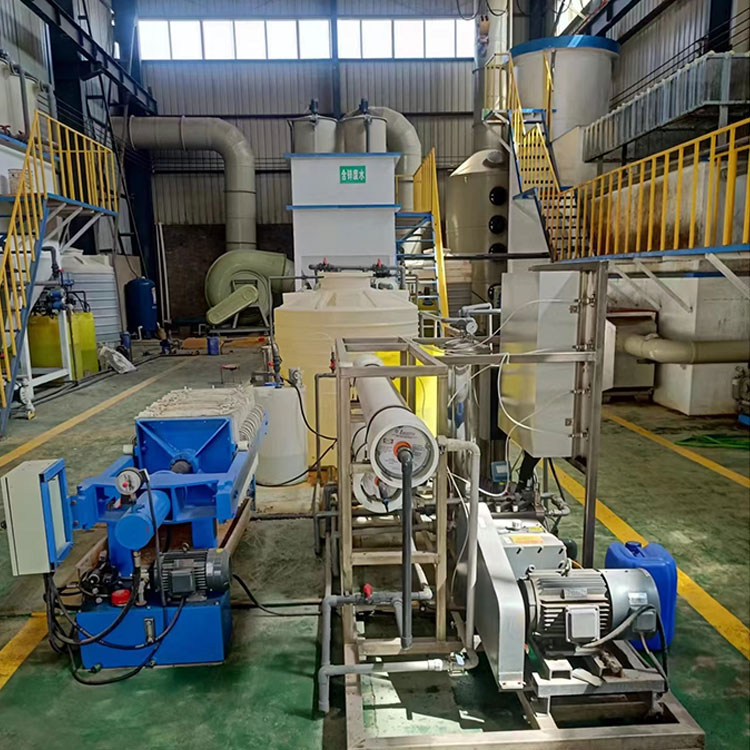
Rather than relying on a single precipitation process, the project uses a closed-loop treatment configuration combining physical separation, acid-resistant two-stage membrane concentration, and concentrate evaporation.
Process Flow
Raw Water → Filter Press Pre-Treatment → pH Adjustment → Ultrafiltration (UF) → First-Stage Reverse Osmosis with Seawater RO Membranes (SWRO) → Second-Stage Anti-Fouling Reverse Osmosis (BWRO) → Treated Water Reused in Suitable Production Applications / Concentrate Sent to Ammonia Removal and Evaporation Systems for Heavy-Metal Retention
Core Equipment Minghua Use
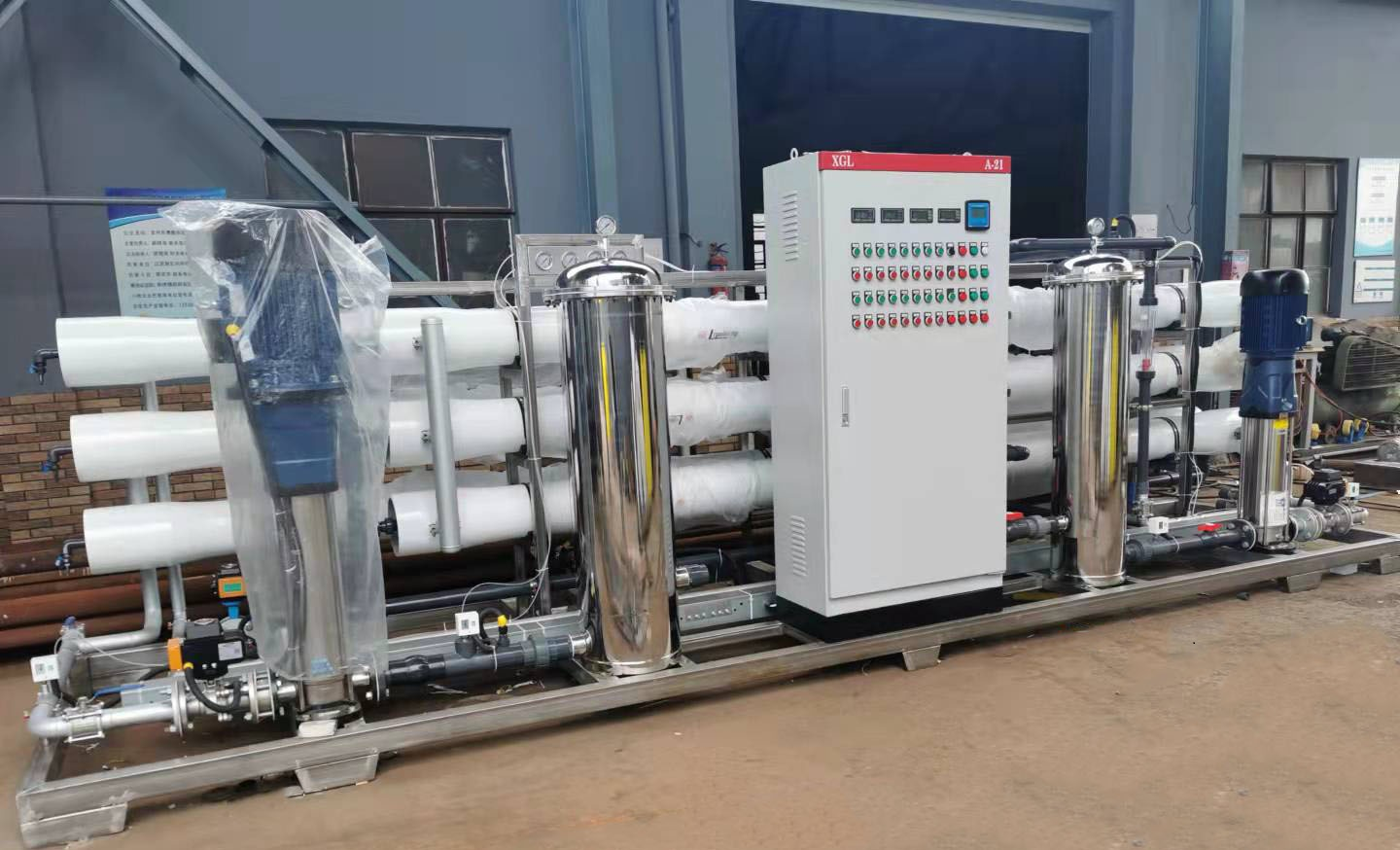
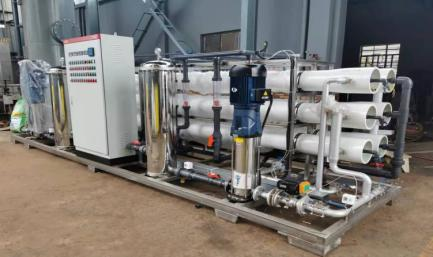
Acid-Resistant, Anti-Fouling Two-Stage RO Skid: The first stage uses high-pressure seawater RO (SWRO) membranes to manage high osmotic pressure and high-salinity conditions. The second stage uses high-rejection, anti-fouling brackish-water RO (BWRO) membranes to provide additional desalination and support product-water conductivity control at ≤50 μS/cm.
Corrosion-Resistant Materials High-pressure piping and wetted valves are constructed using 316L stainless steel, duplex stainless steel, or other suitable corrosion-resistant materials to help reduce corrosion risks in acidic and high-salinity conditions.
Ultrafiltration and Micron-Level Cartridge Filtration: The UF system and micron-level cartridge filters retain fine colloids and hydroxide particles, maintaining the RO feedwater silt density index (SDI) below 2.5 under project operating conditions.
PLC and SCADA Monitoring System: The system monitors influent and effluent conductivity, pH, permeate flow, and transmembrane pressure (TMP). It also includes automatic triggering logic for clean-in-place (CIP) procedures.
Operational Performance and Project Benefits
The project has operated continuously for more than six years. Membrane cleaning, equipment inspection, and preventive maintenance are performed according to the established maintenance plan, supporting stable system operation.
The system recovers approximately 230 t/d of treated water for production reuse applications that meet the relevant water-quality requirements. The project saves more than RMB 500,000 annually in freshwater procurement and purified-water preparation costs.
Nickel-, cobalt-, and manganese-enriched concentrate is returned to upstream leaching or batching operations. The project recovers more than RMB 1 million in metal-material value annually.
The treatment system supports the management of high-salinity, high-ammonia-nitrogen wastewater and helps meet local pollutant-load control requirements and environmental compliance reviews for the new energy industry.
| Parameters | Details |
|---|---|
| Types of Waste Water | Recycled Rinse Water from Ternary Material(NCM) Production |
| Treatment Capacity | 300 m³/d |
| Technology | Membrane Treatment Technology |
| Untreated/Inlet | Conductivity≤ 30000 μs/cm |
| Treated/Outlet | Conductivity≤50 μs/cm |
FAQ
Will RO membranes scale or degrade rapidly when treating acidic wastewater with conductivity as high as 30,000 μS/cm? How long can the membranes operate?
Conventional RO membranes may experience faster performance decline under these conditions. This project uses high-pressure, anti-fouling seawater RO membranes in the first stage to manage higher osmotic pressure and high-salinity wastewater. The system also uses corrosion-resistant 316L high-pressure piping and valves.
Upstream UF retains colloids, while the chemical dosing system applies acid-resistant antiscalants designed for sulfate and metal-ion conditions. Combined with scheduled quarterly CIP procedures, the membrane elements have achieved an operating cycle of more than two years under actual project conditions.
How is the 20%–25% high-salinity concentrate from RO treated?
The membrane system concentrates the original 300 t/d wastewater flow to less than 70 t/d, reducing the volume requiring downstream treatment.
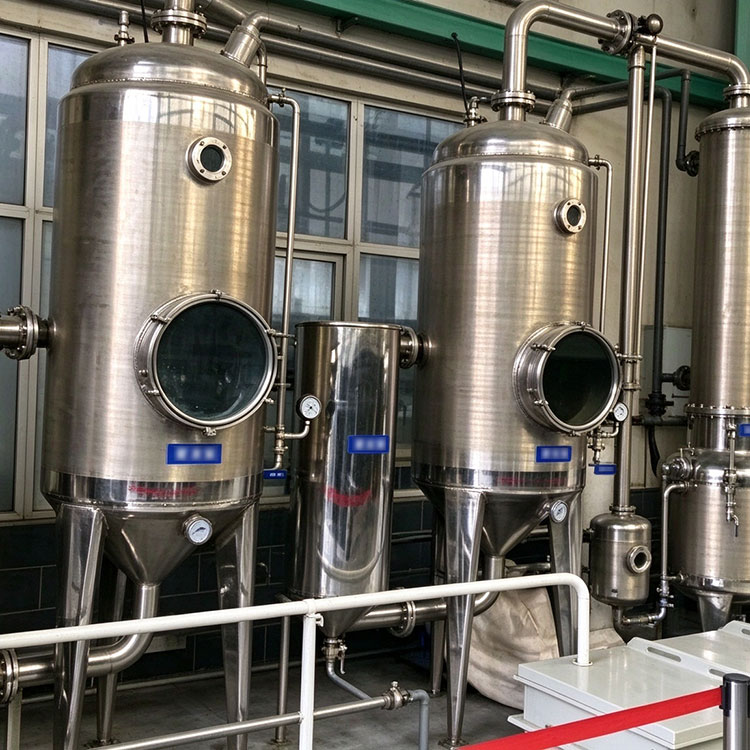
The concentrate is directed to a subsequent ammonia removal system, such as distillation-based ammonia stripping or membrane ammonia removal. After ammonia removal, the heavy-metal-enriched concentrate can be returned to workshop precipitation and batching processes or sent to an evaporator for crystallization and solidification, supporting the resource recovery of heavy metals and salts.
How are nickel, cobalt, and manganese recovered from the washwater, and can the recovery offset part of the equipment investment?
RO reduces dissolved metal-ion loads in the treated water and concentrates a portion of nickel, cobalt, and manganese in the brine stream. Actual metal rejection and concentration performance depend on metal speciation, influent pH, membrane type, recovery rate, salinity composition, and operating conditions.
The concentrated metal-bearing stream subsequently enters ammonia removal and evaporation-crystallization stages. Depending on concentrate composition and downstream process requirements, it can be converted into solid metal salts or returned to upstream production processes for further recovery.
For large-scale ternary material production facilities, recovered metal value and savings from reduced purified-water consumption can help offset part of the wastewater treatment system investment.

 Henan Public Network Security Registration No. 41077102000244